Showing posts with label women. Show all posts

Thursday, March 9, 2017

International Women's Day 2017

Yesterday was International Women's Day! It's one of my favorite Soviet holidays which has turned into a worldwide holiday, and I just like it because it reminds me of the great, strong, inspiring women in my life who remind me that I was born to build.

But it also always, always, always reminds me of Ukraine, as that was the first place where I really celebrated it.

So this year to celebrate, I decided to throw a borscht party with some of my friends. A couple of weeks ago, I found out that a few other girls I know also loved Eastern Europe (one girl volunteered at an orphanage in Moscow years ago and the other girl had a sister who was a volunteer in Russia), and we wanted to get together and eat yummy Russian and Ukrainian food. I suggested March 8th, because International Women's Day is always a great reason to have a party.

And it was just really, really fun. There was a lot of good food: Ukrainian and Russian chocolates, juice (the kompote Chella brought was a.ma.zing.), pretzels, cookies, waffle wafers, and, of course, borscht.

[Ukrainian candies!]

[This is my favorite Ukrainian candy. It's just sooo yummy.]

[I was really proud of this batch of borscht. It was really good.]

Those who had lived in Eastern Europe/had ties to it spent a lot of time reminiscing and telling stories (as well as just basking in nostalgia--one of my favorite things was when people who had lived in Eastern Europe came in, their eyes got big with delight and memory when they saw the goodies on the counter). But it was also great because it was just fun. We were all friends there, so even people who had no ties to Eastern Europe really enjoyed just spending time with friends and trying new things and hearing stories about Ukraine, Russia, and the Baltics. (At least, I think they enjoyed hearing stories. They were nice to listen to them, haha.)

[So. much. food.]


[Friends.]


But in general, there was just a really good vibe.

(Which was improved by Russian music, haha. Because who doesn't like a good, catchy song with Russia's Zac Efron? Watch this video. No really. Just watch it. It is hilarious. And even if you don't speak Russian, it's just a fun song. And it makes me realllllly want to go back to Moscow.)


Anyway, it was just a lovely way to celebrate women, friends, and Eastern Europe.


Women's Day 2015 
Women's Day 2014 
(Apparently I didn't blog about it in 2016, but I know that I celebrated it by remembering Sojourner Truth and eating blini. So. It was a pretty good day.)

Saturday, January 21, 2017

two wings.

Just some thoughts applicable today and every day:

"The world of humanity is possessed of two wings: the male and the female. So long as these two wings are not equivalent in strength, the bird will not fly. Until womankind reaches the same degree as man, until she enjoys the same arena of activity, extraordinary attainment for humanity will not be realized; humanity cannot wing its way to heights of real attainment. When the two wings . . . become equivalent in strength, enjoying the same prerogratives, the flight of man will be be exceedingly lofty and extraordinary." -- Bahai'i Faith, "Two Wings of a Bird"

["Climbing a Very Small Mountain Together," by Caitlin Connolly]
/via/

Wednesday, June 24, 2015

"The Stepsisters' Lament": Or, Why I Cannot Entirely Get Behind the "Real Women Have Curves" Movement

The “real women” movement is making another round on social media. This week, a BuzzFeed article appeared with BuzzFeed writers trying on Victoria Secret swimsuits and then showing what “real” women looked like in them. They said that their point was to show that beauty came in all shapes and sizes, whether you’re a size 2 or 22.

However, the article did not leave me feeling empowered.

Although their final words were “Go models! Go us! Go team, go! We are all amazing!” that felt extremely superficial to me, especially since many of the girls individually complained about their own bodies, the models’ sizes, and models’ lifestyle choices. Instead of female empowerment, I got the impression that this article was really a way for the writers to say, “Look, we are better than these models, because we are real women.”*

Okay, stop. Aren’t these models “real” women, too? I mean, I know that being called “fake” is one of the biggest insults our generation can throw, and I know that these models are airbrushed and photoshopped in these pictures and they have personal trainers to keep them perfectly in shape . . . but aren’t they women? Just because they are models does not mean that they aren’t real. This doesn’t mean that I agree with the media’s impossible conceptions of female beauty (I certainly have an axe to grind about that), but aren’t we all “real women,” regardless of how curvy or straight our figures are? And last I checked, cutting someone down to build yourself up is a hollow way to build self-confidence.  

I know that this is a complicated issue with centuries of baggage. I mean, we can look at history for a glimpse of how standards of beauty have changed: the Gibson girl, the flapper’s boyish look of the 1920s, the curvy 1950s housewife. Pick a century--pick a decade--and you’ll get a different definition of beauty. The only thing that doesn’t change is that society’s view of beauty is always out of reach. The media screams at women (and men, for that matter) to be someone they’re not—that we are too much, not enough, just take off those extra 5 pounds, just get that little black dress, get those razor-sharp abs and you’ll be happy, healthy, rich, popular, and you’ll find true love.

It’s a problem. Our society is inundated with messages that tell us to get, get, get, spend, spend, spend, be more, more, more or less, less, less than what you are and you’ll find the key to happiness.

But we exacerbate the problem when we compare ourselves with others, and then when we despise them when have something that we want . . . or else we applaud ourselves for being “better” than them. Fat-shaming and skinny-shaming both exist. And both need to stop.

I believe that we, as women, are our own worst critics—not only of ourselves, but of others. Of course it’s human nature—we seem to have this drive to pit us vs. them, and we hate it when others succeed (even if it’s not something we even wanted in the first place). I know that everyone—men and women—are capable of pettiness. Like I said, it is human nature. We seem to regress to our 7th-grade selves and simultaneously hate and try to emulate the popular kids, thinking that “they” somehow hold the secret to happiness, while forgetting that the key to human happiness was always in ourselves.

Before we know it, we are acting like the stepsisters from Cinderella. And I don’t just mean the Disney Cinderella you’re familiar with. I mean the Grimms’ Brothers version, which isn’t your typical Disney tale. There is blood—and a whole lot of it. Bear with me for a bit while I describe the story--there's a point, I promise.


The basic outline is the same—girl is mistreated by her stepfamily, she gets a ball-gown and slippers from a magic tree and birds, she goes to the ball, loses her shoe, prince searches for her, finds her, and they start a new life together. But the different details make the Grimm version, well, a lot more macabre . . . and the stepsisters don’t end up merely angry, annoyed, and heartbroken. They end up mutilated.  

When the prince comes by to have the stepsisters try on the slipper, the stepmother takes her first daughter aside and has her try on the shoe. The first girl almost gets her foot in . . . but her big toe doesn’t fit.

So her mother tells her to cut it off.

The stepsister and prince are about to ride off into the sunset when Cinderella’s bird friends alert the prince to the fact that there is blood in the slipper. So he takes the girl back home and this time the second stepsister tries on the shoe.

The same thing happens. The shoe almost fits . . . except for her heel.

And her mother tells her to cut her heel off. “When you’re queen, you won’t need to walk.”

So the girl cuts off her own heel.

The prince takes her home, but then again is alerted to the fact that there is blood in the shoe.

Finally Cinderella gets her chance to try on the shoe (but with all of that blood in it? Ewwww. The things we do for love). She tries it on, it’s a perfect fit, and they all live happily ever after . . . except for the stepsisters, who are angry, bloodied, and unable to walk. They have broken and mutilated themselves in order to obtain what they thought would make them happy—a prince, a title, power, wealth. And in the process of wanting to be something they're not, they end up unwhole. 

Since this is a fairy tale, there are multiple layers of meaning, and it provides commentary on society—even for us in the 21st century. Here are some things to consider:

1. First of all, why did the prince choose Cinderella? Because she was the most beautiful? The tale suggests that. And, you know what, that is extremely shallow. The prince has his own issues to work out. And so does society. That doesn’t mean Cinderella was better or worse than any of the other girls there. It simply means that she is who the prince chose. But Cinderella didn’t ask to be chosen. Maybe Cinderella went to the ball simply because she wanted a night out, or she wanted to dance. And maybe the prince was first drawn to her by her beauty, but maybe he fell in deep infatuation with her because she sang really well, or she made him laugh, or they both had a love for polished banisters, or she could talk political theory like nobody’s business. We don’t know. Just like we don’t exactly know why one girl is chosen as beautiful in society’s or a man’s eyes and we are not. But does it really matter? Some of us are naturally straight. Other gain weight easily. Some of us are models. Others are doctors, or writers, or business consultants. Some of us will be accepted by society. Others will not. Some of us will find love easily. Others will not. But society’s view of your worth or beauty does not add nor take away from who you are.

2. I feel really bad for the stepsisters. Their story is tragic to me. They are trying to fit this “one-size-fits-just-one” standard of beauty, love, and acceptance. And it’s just not going to work. They are never going to fit in that shoe. They just aren’t—they’ve grown into their feet and their feet aren’t changing sizes, no matter how hard they wish or try. The only way they fit into the shoe is by mutilating themselves and making themselves unwhole. It’s tragic because so many of us do the exact same thing. We give up important parts of us in order to fit the mold of the “perfect woman.”**

For example, I once knew a girl who told me that she was known as the “smart girl” in high school. She hated it, because she felt that the “smart girl” was not—and never would be—the “pretty girl” or the “hot girl” to the guys she knew. She felt unnoticed by boys and she wanted to be known as beautiful. And so, she changed in college. She dumbed down and tried to become what she assumed others wanted her to be so she could be called beautiful. And she was called beautiful. By many men. But they stopped calling her smart. As she told me her story she whispered, “I wish they would call me smart again.”

It broke my heart, because she had given up an important part of herself to fit a mold—a preconceived notion of “true” womanhood. This is not my story, but most—if not all—of us have done things like this. We give up a good part of ourselves in order to fit a mold—in order to fit a glass slipper we might not even truly want. When we focus too much on what we are not, we miss who we are. And when we try to force ourselves into a mold of beauty, we end up bruised, squashed, and mutilated.

3. The stepmother is the scariest person in this fairy tale. Why? Because she is the one enforcing and encouraging her daughters in these impossible standards of beauty. The stepsisters didn’t get the idea to cut off their heels and toes. That came from their mother. The stepsisters didn’t make Cinderella the household slave. That was their mother. For better or for worse, mothers play a HUGE role in the way their daughters view themselves and their place in society. And, regardless of how our mothers taught us about our bodies and healthy relationships, we can choose how we will teach the children we will raise, teach, and mentor about their own body images. We can teach them to be kind to others, to build instead of tear down, and to exude the beauty of confidence that will draw others to them so they in turn can heal, lift, inspire, and bless.

I once knew a fourteen-year-old girl with straight brown hair, big glasses, and a shy smile who was terribly insecure about her changing body. She was convinced that she would never live up to the expectations created by society, her peers, and her mind. I also know that what changed the way this girl looked at herself in the mirror was that her mother noticed that something was wrong, took her aside, and talked to the girl about what true beauty really was and where her worth truly began. It wasn’t in a dress size, shoe size, IQ, the number of school dances she went to, or the age when she had her first kiss. Her beauty and worth could not be measured. Beauty—true beauty—real womanhood—was in the curve of her smile, the light in her eyes, the furrow in her brows, and the crinkle in her nose. It was in the spread of her hands and the size of her heart and the swing of her hips. It was in the strength of her legs and the point of her toes. It was in the truth she spoke and the love she gave, even when nothing else was given in return except silence and scorn. It was the forgiveness she offered and the care of her touch. It was in the resilience of her spirit and the grace of her soul.

That little girl was me. And my mother’s example, encouragement, and goodness have taught me more about beauty and being a “real” woman than any manifesto, celebrity empowerment song, or social media campaign. I do realize that not everyone has a mother like this—a mother whom they can communicate with and trust. Nor do I have everything figured out. But I do believe that we can be in control. Healthy bodies, healthy body images, and healthy relationships start with us. We don’t have to put others down to make ourselves more “real” and therefore more “beautiful” than the other.

If I should have a daughter, I want her to know this. I want her to know that there is nothing quite so powerful as a girl or woman who knows that her main strength isn’t her beauty. But rather, true beauty is strength. Because once we know who we are and stop wishing for what we aren’t, we are better able to love others for who they are—and who they can become. We don’t compare ourselves to others. And we know that someone else’s beauty does not mean that they outshine us or we outshine them.  We see beauty everywhere, because we walk in the beauty of confidence.

Real women aren’t silhouettes.

We are powerful forces for good.


*I also realize that maybe all these girls wanted to do was start/continue the conversation about “true beauty.” Well, congratulations. I took the bait and have entered the conversation.

**I know that body dysmorphia, anorexia, and bulimia are very real and serious issues, and they deserve special care and attention . . . but I am not qualified to give that attention. I certainly did not write this blog post with the intent of making anyone who might have eating disorders feel ashamed. If you or someone close to you is struggling with any of these issues, please know that there is hope. You don’t have to deal with these difficulties on your own. There are people who can help you.


Thursday, March 12, 2015

"Can you describe this?" And I answered, "Yes, I can."

I have been falling in love with the words of Anna Akhmatova.

For those who don't know, Anna Akhmatova was a poet in the Soviet Union. She lived through Stalin's purges and the Great Terror of the 1930s. 

And she refused to be silent. 

Oh, Anna. How to describe Anna? I feel like my words don't do justice to her resilience, grace, and strength. (But if you do want to read a beautiful, stunning post on Anna Akhmatova, you should read Em's blog post about her here.)

But, if there is anything I will say, I will say that Anna Akhmatova was strong. Oh, was she ever strong. 

She had everything taken from her. Her son was arrested and sent to the Gulag. Her husband was killed. Many of her closest friends were also arrested and executed.

But she refused to give up. And she refused to run away. 

About a month ago, I decided to write about Anna Akhmatova for my Soviet history class. I decided that I needed to study a resilient woman. I needed to study her life in depth. And so I chose Anna. 

I haven't been disappointed. 

Can I share with you a few of her poems that I love? There is just so much emotion in them. So much raw emotion and strength. They were both written during the 1930s. During that time when so much innocent blood was spilled and so many lives were destroyed. 

This one was written in 1933, and talks about the blood spilled by the Bolsheviks: 

Wild honey smells like freedom, 
Dust--like a ray of sun, 
Like violets--a young maid's mouth, 
And gold--like nothing. 
The flowers of the mignonette smell like water, 
And like an apple--love. 
But we learned once and for all
That blood only smells like blood . . . 

And in vain the vice-regent of Rome 
Washed his hands before all the people, 
Urged on by the ominous shouts of the rabble; 
And the Scottish queen 
In vain washed the spattered red drops
From her slender palms
In the stifling gloom of the king's home . . . 

I don't know why this poem resonates so deeply with me. "But we learned once and for all/That blood only smells like blood." That line. It gives me chills. Especially after learning so much about Soviet history the past couple months. The quotas. The prisons. The show trials. The blood. How do we let ourselves lose our humanity? "Blood only smells like blood." 

The other poem which has deeply affected me is her Requiem. This cycle of poems is . . . there's not a proper word in English to describe it. But it is extraordinary. Simply exquisite. She tells her story of losing her son to the NKVD and then waiting in line outside the prison walls of Leningrad--waiting for hours, days, months, years--for something--anything--some kind of information about his fate. But this poem isn't just about her. It is about all of those women in Leningrad. It is their story. She gives voice to the voiceless so that history will not forget. 

And Requiem beautifully captures the despair of the time. The anguish. The grief of a nation and of the women of this nation. But there is also an element of hope Requiem. A sense of dignity. The promise that she will not give up, so that history will remember. Evidence that the human spirit cannot be crushed. And it is incredible. 

Here are some of my favorite parts of Requiem: 

Instead of a Preface

In the terrible years of the Yezhov terror, I spent seventeen months in the prison lines of Leningrad. Once, someone "recognized" me. Then a woman with bluish lips standing behind me, who, of course, had never heard me called by name before, woke up from the stupor to which everyone had succumbed and whispered in my ear (everyone spoke in whispers there): 
"Can you describe this?" 
And I answered, "Yes, I can." 
Then something that looked like a smile passed over what had once been her face. 

VII
The Sentence

And the stone word fell 
On my still-living breast. 
Never mind, I was ready. 
I will manage somehow. 

Today I have so much to do: 
I must kill memory once and for all, 
I must turn my soul to stone, 
I must learn to live again--

Unless . . . Summer's ardent rustling
Is like a festival outside my window. 
For a long time I've foreseen this 
Brilliant day, deserted house. 

Epilogue I 

I learned how faces fall, 
How terror darts from under eyelids, 
How suffering traces lines
Of stiff cuneiform on cheeks, 
How locks of ashen-blonde or black 
Turn silver suddenly, 
Smiles fade on submissive lips
And fear trembles in a dry laugh. 
I pray not for myself alone, 
But for all those who stood there with me
In cruel cold, and in July's heat, 
At that blind, red wall. 

Her words are powerful. Powerful, real, and stunning. She speaks for all the women--the mothers, wives, sisters, daughters, and others--who stand by that brick wall at Kretsy Prison, waiting, hoping, praying for some news . . . even if it is the worst news. 

Because that not knowing is the worst of all. 

But she wrote so that the world would know. 

I've studied a lot of poets in my life. But I think . . . I think that if I could write like anyone, I would choose to write like Anna Akhmatova. 

Sunday, March 8, 2015

Sisters. My sisters.

Today is International Women's Day.


I love this day. For many reasons.

One, I love the chance to celebrate womanhood and sisterhood. A chance to celebrate, simply because I am a woman? Sign me up. I always love a reason to party.

But in all seriousness, I am all for celebrating the women in my life and women who have influenced me. I am surrounded by so many incredible women in my life. It is one of the greatest blessings of my life--to know so many incredible, strong, bright, ambitious, kind, beautiful, intelligent women. Women I call my sisters and friends.


Two, celebrations with fresh flowers are always a good idea. Always, always.

Three, Women's Day reminds me of Ukraine. It reminds me of the first International Women's Day I ever truly celebrated. I remember walking the streets of Kharkov, wishing the women around us a Happy Women's Day, and receiving well-wishes from those we passed. I remember getting bright yellow flowers from people on the street, and I remember this general air of freshness and happiness--a spot of spring amidst the grey apartment buildings around us.

Women's Day reminds me of the strength of the women of Ukraine.

They are resilient.
They are beautiful.
They are blunt.
They are dignified.
They are phenomenal.

Phenomenal women.


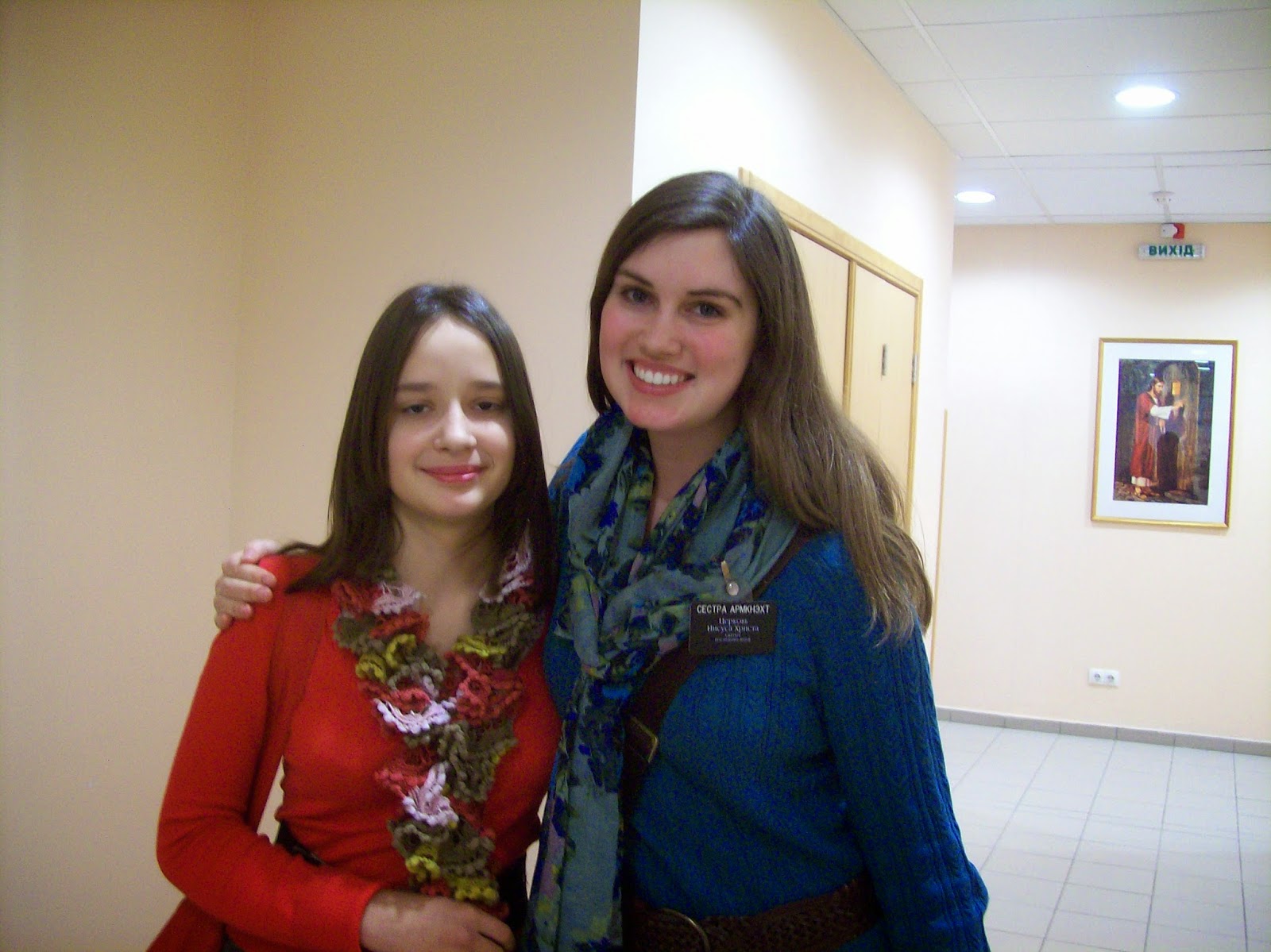
I met so many women on the streets of Ukraine. And they are all my sisters. My beautiful, strong, incredible sisters. I still am humbled that I was able to live with them for a period of my life. They taught me so much. They let me into their lives. And in return, they touched my own life in ways that I cannot even begin to repay.

Because when a woman lets you into her life, she will give you her heart.

Can I tell you a story? It is a story I had forgotten about until recently. It is a story from Ukraine. A mission story. (I know, I know. I talk about my mission all of the time. I can't help it. Truly, I can't. You can take a girl out of the mission, but you can't take the mission out of the girl. Story of my life.)

On a mission, you meet people from all walks of life. One night my companion and I were going to a woman's home to share a message about faith and to invite her to come to church with us that Sunday. We had met with this woman before. We knew her story. And she had let us into her life . . . and she had told us everything--her past, her hopes, her dreams, her fears. She trusted us; she loved us because we honestly cared for her. And even though she had had a very colorful past, she loved us because we had hope for her. We saw her potential. And she could feel that.

Anyway, one night when we were at Vika's, and she had invited a friend to come listen to us. Her friend was also far from perfect (to put it nicely), but I was struck that Vika had invited her friend to listen to us. I'm going to quote straight from my journal to tell the rest of the story, because I feel it tells it better than I could retell it:

"On Tuesday we met with Vika again. Her friend Tatyana was there. And we were able to have a nice discussion about Alma 32 and faith. But what struck me most about this meeting was the symbolism. Vika and Tatyana are both pretty greshni (sinful). Tatyana is living with someone who isn't her husband, and Vika has done that too, at points in her life.

"And this meeting reminded me of how the Savior had dinner at publicans' and sinners' homes. And how adulteresses would lay down and cry at His feet, wiping His feet with their long, sleek hair. How He was at ease with the saint and the sinner--because He loved them. We're all greshni (sinful) before God--whether adulteresses or apostles. But we are all invited to come unto Him. He turns none away.

"I was grateful for a deeper insight into His life tonight--me, sitting on a broken couch in inner-city Kharkov, Ukraine, dining with adulteresses."

Why do I tell this story on Women's Day? I'm not entirely sure, to be honest. Because it reminds me of Ukraine? Perhaps. It does remind me of the many women that I met there and that I continue to meet. The women who are striving. The women who are hurting. The women who fall and the women who succeed. All of us.

But I also feel like there is a deeper connection here, something that I am still trying to put my finger on.

I think it has something to do with sisters.

And something to do with love.

For these women--all of the women I met in Ukraine--all of the women I associate with--they are my sisters. There is a bond in womanhood. A strength in sisterhood.

And my sisters are beautiful. Glorious. Phenomenal. Imperfect. But extraordinary.

And still we rise.

So, my dear sisters. Happy Women's Day. С днём женщин! I would buy you all flowers if I could. But I do wish you success, happiness, health, love, and hope for the future. 

С праздником, дорогие сёстры!

Happy Women's Day, my dear, dear sisters. 

I love you.